How many conserved quantities are there?
In classical Newtonian mechanics as taught in high school, we're familiar with various conserved quantities: The most important ones are energy, momentum and angular momentum. In a more sophisticated setting, we think of these as due to certain symmetries of the system or its Lagrangian. Energy conservation is due to time translation symmetry, momentum conservation is due to spatial translation symmetry, and angular momentum conservation is due to rotational symmetry.
A couple of years ago (2021), I noticed a pattern about the character of these conserved quantities in the context of geometric algebra (or more generally Clifford algebra):
Let's look at a particle freely moving in 1D space. The system has two conserved quantities:
- The energy of the particle, which is a scalar quantity.
- The momentum of the particle, which is a vector quantity.
Now let's look at a particle freely moving in 2D space. The system has three conserved quantities, one more than in 1D:
- The energy of the particle, which is a scalar quantity.
- The momentum of the particle.
- The angular momentum of the particle, which is a bivector (or pseudovector) quantity.
We often think of the angular momentum as a vector in 3D, but in fact it stems from a bivector , which is a 2D conserved area. The two are related through a Hodge dual, , which maps areas onto surfaces. This works because there are three orthogonal vectors and three orthogonal planes in 3D, so each bivector can be mapped onto the vector in the orthogonal direction. Kepler's second law that a constant area swept out by an orbit over time makes this very apparent and is a very natural consequence of the conserved angular momentum being an area-like bivector quantity.
This pattern seems to hold in a more complicated case, e.g. that of two orbiting bodies. The system can be reduced to two dimensions, parametrized e.g. by the distance and angle between the bodies. Just like for the free 2D particle, we get tgree conserved quantities:
- The total energy, a scalar quantity.
- The Laplace-Runge-Lenz vector.
Despite the cross product, this object is in fact a vector, not a bivector, and can be expressed in terms of the following wedge product:
- The system's angular momentum.
For completeness, a particle in 0D can be seen as having only a single (somewhat trivial as there's no space to move through!) conserved quantity, a scalar energy, but no momentum vector or angular momentum bivector because there's no vector space for these quantities to exist in.
For each additional dimension we seem to get a new conserved quantity! Can we extend this to 3D?
In the 3D case there are no fundamental physical conserved quantities that immediately come to mind, but for example: We can also think of the trivector , which defines the orientation or handedness of the coordinate axes relative to each other. This trivector can be converted into a pseudoscalar through a Hodge dual, and in that form can take the value +1 or -1 depending on the orientation of the coordinate system. So this is another conserved quantity which is volume-like. More examples later.
The overall pattern seems that in higher dimensions, we get one conserved quantity for each additional grade of blades in the algebra. This would mean that in D, we'd have:
- Scalar energy
- Vector momentum
- Bivector angular momentum
- Trivector (or 3D) conserved volume of some sort
- Quad-vector (or 4D) conserved hypervolume of some sort
- ...
- D conserved D volume (or pseudovector) of some sort
- D conserved D volume (or pseudoscalar) of some sort
What's also apparent from the Keplerian example is that the conserved quantities can take an unexpected form like the Laplace-Runge-Lenz vector. This indicates that there may still be conserved quantities in systems that don't have a clear symmetry, so maybe each system has a fixed number of them but they are non-trivial to express or find, but an existance proof could be given by the dimensionality of the system.
This hypothesis is cool because it would predict that there are more conserved quantities in higher dimensions, and we might be able to understand them in terms of the allowed grades, or as part of a single conserved multivector unifying all of them into one object.
While it turns out that this hypothesis is wrong in this formulation, but it's wrong in interesting ways that are worth talking about. In particular, going through this exercise helped me more clearly understand the nuances of constants of integration, conserved quantities (Noether charges), gauges and scale invariance (internal and external), and what the Buckingham theorem really tells us. This should be quite the ride.
Support for higher grade conserved quantities
Digging through the literature, I found it hard to find examples of higher grade conserved quantities in classical mechanics, and no
clear writeup of the pattern or a clear conterfactual. I did find something in a book Geometric Algebra for Physicists, Chapter 9
in a section on invariants a relativistic two-particle (maximally entangled) singlet state. A table summarizes the relativistic invariants of the system,
which follow the pattern of one invariant for each grade of the algebra.
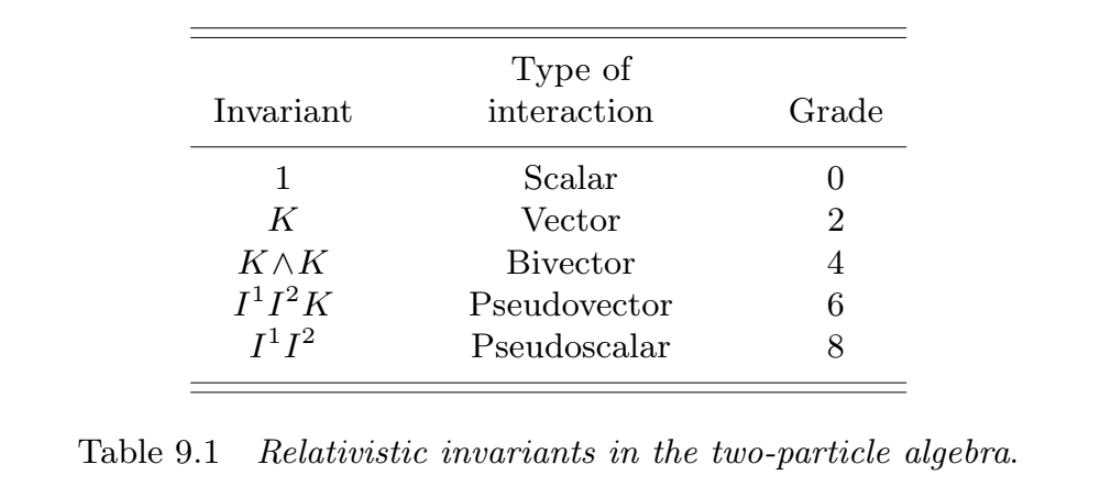
The invariants here are constructed from the basis vectors and of two copies of the spacetime vector basis sets, one for each particle. This purely geometric construction produces a series of quantities of increasing grade that are invariant under Lorentz boosts. They are, however, not necessarily conserved quantities in the sense of Noether's theorem, and they are not generators of any symmetries.
Also in the context of special relativity, there is the Pauli–Lubanski pseudovector, which is a legitimate conserved quantity. We can construct the Pauli–Lubanski pseudovector like this:
where is the relativistic 4-momentum and the angular momentum tensor as the sum of the orbital angular momentum and intrinsic spin:
or because :
so
The Pauli–Lubanski pseudovector is called pseudovector because it is actually the Hodge dual of a trivector. This construction commutes with the Hamiltonian (as and both commute) and is a conserved quantity. On its own it's not Lorentz invariant, but is. However, it's also one of the two Casimir invariants of the Poincaré group, alongside . These two operators are part of the center of the algebra, which means they commute with all other operators, and thus behave like the identity times some scalar Because of this they only give rise to trivial symmetries, and the Pauli–Lubanski pseudovector is a conserved quantity, but not a symmetry generator.
As some non-relativistic examples, there are several pseodoscalar quantities in 3D systems that correspond to Hodge duals of trivectors:
One prominent example is the helicity of a fluid flow. Under the Euler equation in hydrodynamics an ideal, incompressible, inviscid fluid with velocity field and vorticity , has a helicity density:
or for the trivector:
An analog of this is the magnetic helicity in electromagnetism, the integral over which is a conserved quantity in the absence of resistivity. The vector potential
After integration both retain their pseudoscalar character, and are conserved quantities:
transforming like a volume (unlike energy which is invariant under parity).
One final example is the phase space volume of a system of particles in 3D, which is conserved under Liouville's theorem:
More generally, incompressible, divergence-free flows (i.e. ) preserve volumes by definition.
What exactly is a conserved quantity?
At this point I realized I had been using the phrase conserved quantity too loosely.
There are at least four different things that tend to get bundled together:
-
First integrals / constants of motion.
These are functions on phase space that remain constant along a trajectory. -
Noether charges.
These are a special class of first integrals that arise from continuous variational symmetries of the action. -
Integration constants.
These are the free parameters needed to specify a particular solution of the equations of motion. -
Invariants.
These are quantities unchanged under some transformation or group action. Some are dynamical conserved quantities, some are not.
Those distinctions matter. A system can have invariants that are not Noether charges, Noether charges that are not all independent, and lots of integration constants that are not conserved in any interesting sense.
This is exactly where my original "one conserved quantity per grade" idea started to come apart. The Clifford algebra grades are telling us what kinds of geometric objects can exist. They are not directly telling us how many independent dynamical first integrals the system must have.
So the right question is not:
how many grades are available?
but rather:
which functions on phase space stay constant along the motion, and which of those come from genuine symmetries?
Generators, flows, and why exponentials show up
One reason the confusion is tempting is that continuous symmetries really do come from infinitesimal generators, and exponentials really do turn those generators into finite transformations.
In quantum mechanics, Stone's theorem says that a strongly continuous one-parameter unitary group can be written as
with self-adjoint. The generator determines the full flow.
Classically the same idea shows up in a less operator-heavy form. We can write
Given a vector field generating a flow , the finite transformation is obtained by integrating the infinitesimal one. This can also be
interpreted as applying the infinitessimal generator of the group flow over and over, which we call the exponential map on that particular Lie group.
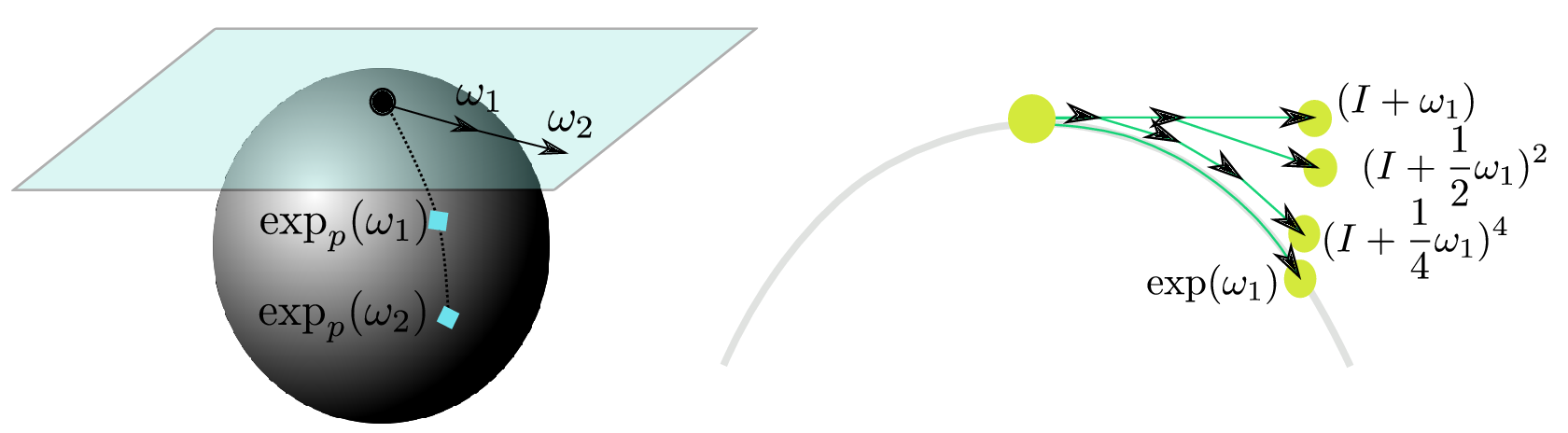
In this figure, the flow generator is a tangential flow relative to the surface of a sphere. Applying it once displaces us tangentially off the sphere. Splitting the step in two and applying two iterations of the map creates some curvature, as the second iteration accounts for the new curvature direction. Increasing the number of iterations towards and the step size towards , we arrive at the exact exponential map. The repeated application of small steps is similar to numerical Euler Integration, and is in fact one of the ways the classical exponential function is defined on the real/complex numbers.
Likewise, on phase space the Hamiltonian generates time evolution by the Poisson bracket:
so the finite evolution of an observable can be written schematically as
The same logic explains why translations and rotations look exponential.
A translation along a constant vector is generated by the directional derivative :
A rotation is generated by an antisymmetric linear map, which in geometric algebra is naturally represented by a bivector . The finite rotation is then
This is the useful part of the "grade" intuition: bivectors really do generate rotations in a very clean way.
But that does not mean every higher-grade blade gives a new continuous spacetime symmetry. That is the step where the naive pattern fails.
Do trivectors or higher-grade blades generate new continuous symmetries?
Not in the simple way I originally hoped.
A general multivector can be written as
and one can certainly exponentiate many such objects algebraically. But algebraic exponentiation alone does not guarantee a physically meaningful symmetry of the system.
For ordinary orthogonal geometry, the continuous transformations connected to the identity are generated by bivectors. These exponentiate to rotors, and rotors act on vectors by grade-preserving sandwiching.
That is why bivectors sit at the heart of rotations and Lorentz boosts.
Odd-grade elements are different. A unit vector can generate a reflection, but reflections are discrete, not part of the connected one-parameter family of proper rotations. More complicated odd-grade exponentials do not generically produce new continuous geometric symmetries of the tangent space that preserve the structure needed for an ordinary mechanical symmetry.
So the moral is:
- bivectors naturally generate continuous orthogonal transformations;
- vectors generate flows on the manifold as differential operators, such as translations;
- higher grades can be geometrically meaningful without being new Noether generators.
This already kills the simplest version of the original hypothesis. There is no general ladder in which each new grade automatically contributes a new continuous symmetry and hence a new Noether charge.
Where higher-grade objects really do show up
This does not mean higher-grade objects are irrelevant. It means they show up in more subtle ways.
1. Casimirs and algebraic invariants
In relativistic mechanics and field theory, some important quantities are invariants of the symmetry algebra rather than generators of new symmetries.
A good example is the Pauli–Lubanski vector
This is dual to a trivector-like object built from angular momentum and momentum. The key invariant statements are about
the two Casimir invariants of the Poincaré group. These label mass and spin. They are central invariants of the representation, not extra spacetime symmetry generators.
So here we do get higher-grade geometric structure, but not in the "new grade new Noether charge" sense.
2. Helicity-type pseudoscalars
In three spatial dimensions, there are genuine pseudoscalar conserved quantities.
For an ideal barotropic fluid, the fluid helicity is
In differential-form language this is built from a 1-form and its exterior derivative, schematically , so it has the character of an integrated 3-form.
In ideal magnetohydrodynamics, the magnetic helicity is
or in forms language
These are real conserved quantities, and they do transform as pseudoscalars under parity. But again, they do not arise because "3D must come with a trivector Noether charge." They arise because the dynamics preserves a certain topological linking structure.
3. Volume forms and measure preservation
Liouville's theorem says Hamiltonian flow preserves phase-space volume:
This is a conserved top-degree form. It is extremely important. But it is a statement about preservation of the symplectic measure, not an extra first integral in the same sense as energy or angular momentum.
So higher-grade objects absolutely occur. They are just not counted the same way as ordinary scalar constants of motion.
The end of the line for isometries: Killing vectors
Another place I went wrong originally was trying to treat higher-grade objects as if they generated ordinary spacetime isometries on the same footing as vectors.
They do not.
For a metric , an infinitesimal isometry is generated by a vector field , and the condition is
or equivalently,
That is the Killing equation.
The point is very simple: the Lie derivative is defined along a vector field. Isometries of the manifold are generated by vectors, not by arbitrary multivectors. The bivector language reappears only after you look at the antisymmetric derivative , which encodes the infinitesimal rotational part of the isometry.
This also explains the standard bound on the dimension of the isometry algebra in dimensions:
Why this number? At a point, a Killing vector is determined by:
- its value : parameters,
- its antisymmetric derivative : parameters.
Adding them gives
In flat 3D space this is translations plus rotations.
Notice what is not in that counting: there is no extra slot for trivector-generated isometries. The ordinary continuous isometries are already exhausted by translations and rotations/boosts.
So if higher-order conserved quantities exist, they have to come from somewhere else.
Hidden symmetries: Killing tensors and Killing–Yano forms
This is where the story gets more interesting.
There really are conserved quantities that do not come from ordinary isometries. The right mathematical objects here are not "higher-grade symmetry generators" in the naive sense, but higher-rank Killing objects.
Killing tensors
A symmetric rank- Killing tensor satisfies
If is the momentum along a geodesic, then
is conserved.
This gives genuine first integrals polynomial in momenta. They are not generated by ordinary Killing vectors, so they lie outside the isometry count.
Killing–Yano forms
An antisymmetric -form satisfying the Killing–Yano equation also generates hidden structure. In index form one common version is
These objects can often be "squared" to produce symmetric Killing tensors, and hence conserved quantities quadratic or higher-order in momenta.
This is the mathematically correct place where blade-like antisymmetric objects re-enter the story. They matter, but indirectly.
Example: the Carter constant
The classic example is the Kerr spacetime. In addition to energy and axial angular momentum, there is an extra conserved quantity, the Carter constant, associated with an irreducible rank-2 Killing tensor.
That extra conserved quantity is real and important. It is not counted among the ordinary isometries. This is exactly the kind of phenomenon my original heuristic was trying to point toward, but the right language is hidden symmetry, not one-new-charge-per-grade.
Example: Runge–Lenz revisited
The Kepler problem is the nonrelativistic prototype. The Laplace–Runge–Lenz vector is not simply "the vector-grade conserved quantity for 2D or 3D." It is a manifestation of hidden dynamical symmetry. In modern geometric language it is related to higher-order Killing structure in appropriate reformulations of the problem.
So the correct lesson from Kepler is not "every grade shows up once." The correct lesson is:
some systems are more symmetric than their obvious spatial isometries suggest.
That is a much better statement.
Higher-derivative Lagrangians do not automatically give more Noether charges
Another tempting idea is that increasing the order of the Lagrangian should increase the number of conserved quantities.
That is not true in general.
Suppose the Lagrangian depends on derivatives up to order :
For a nondegenerate system with configuration variables, the Euler–Lagrange equations are generically of order . So the local space of solutions is specified by integration constants. Equivalently, the Ostrogradsky phase space has dimension .
That tells you how many initial-data parameters there are.
It does not tell you how many Noether charges there are.
The number of Noether charges depends on the actual continuous variational symmetries of the action. A generic higher-derivative system can have very few. Sometimes only time-translation symmetry survives, giving only the conserved energy-like quantity.
There are, however, special higher-derivative models with enlarged symmetry.
For example, for the pure higher-derivative free model
there is an obvious polynomial shift symmetry
because the -th derivative kills all lower-degree polynomials. That special model therefore has extra conserved quantities.
So higher derivative order can allow more symmetry in special cases, but there is no universal formula like "order implies Noether charges." That is a property of particular highly symmetric models, not of higher-derivative mechanics in general.
Constants of integration in geometric algebra language
If a nondegenerate system in dimensions is governed by equations of order , then a local solution is specified by scalar integration constants.
Geometric algebra can package that data in more structured ways.
For example, in 3D one can trade three scalar constants for one vector-valued constant, or organize several constants into bivector or multivector form if the geometry suggests it.
This is useful. It can reveal hidden structure. It can make symmetries easier to see.
But it does not change the amount of information.
So this is another place where the original heuristic overreached. Repackaging constants into blades of different grades does not create new independent conserved quantities. It only changes the bookkeeping.
Buckingham theorem is about dimensions, not automatically about dynamics
The Buckingham theorem is another object that looks suspiciously like a conservation-counting rule if you squint at it the wrong way.
Suppose a problem involves dimensional variables built from independent base dimensions. Then there are independent dimensionless combinations, the -groups.
That is a statement about dimensional analysis and scaling structure.
It is not, by itself, a statement about Noether symmetries.
A true scale symmetry of the action can produce a Noether current or a conserved dilatation charge. But a dimensionless -group can also arise for much more boring reasons having to do with units and parameter counting. The existence of a -group does not mean the dynamics has an exact conserved quantity associated with it.
So these are different kinds of information:
- Buckingham : how many independent dimensionless combinations can be formed;
- Noether: which continuous variational symmetries the action actually has;
- integration constants: how many parameters specify a solution.
These numbers can be related in special examples, but there is no universal identity equating them.
Global symmetries, gauge symmetries, and why gauge does not count the same way
Another correction that matters in any counting argument: gauge symmetries are not the same as physical global symmetries.
A global continuous symmetry gives a physical Noether charge.
A gauge symmetry is a redundancy of description. In the Hamiltonian picture it is tied to first-class constraints and removes physical phase-space directions rather than adding new physical states.
For a constrained system with
- first-class constraints,
- second-class constraints,
the physical phase-space dimension is
Each first-class constraint removes two dimensions after gauge fixing; each second-class constraint removes one.
This is the correct place to do entropy/state-counting style bookkeeping. Gauge directions should not be counted as physical degrees of freedom.
Symmetries in extended configuration space
One can go even more general and consider symmetries acting not just on configuration space, but on an extended space including time and sometimes parameters.
This is often useful, but it also increases the chance of mixing together several notions that should be kept separate.
A transformation in extended configuration space may be:
- a genuine variational symmetry of the action;
- a reparametrization;
- a change of units or scaling convention;
- a gauge redundancy;
- a useful equivalence that identifies families of solutions.
Only the first of these automatically gives a Noether charge.
So the right procedure is:
- define the space you are acting on,
- specify the transformation,
- check whether the action is invariant up to a total derivative,
- quotient out gauge redundancies separately,
- only then count the resulting physical charges or state-space dimensions.
This is less romantic than "one conserved quantity per grade," but it is actually correct.
Final answer
So what is the answer to the original question?
The clean answer is:
there is no universal rule saying that an -dimensional system has one conserved quantity for each Clifford-algebra grade.
What is true instead is the following.
1. Available grades do not determine the number of conserved quantities
The Clifford algebra tells you which kinds of geometric objects can exist: scalars, vectors, bivectors, trivectors, and so on.
It does not tell you how many of those will appear as independent first integrals of a given dynamical system.
2. Ordinary continuous spacetime symmetries stop with Killing vectors
For an -dimensional metric geometry, the continuous isometries are generated by Killing vector fields. Their algebra has dimension at most
Bivectors appear as the antisymmetric part of the derivative of a Killing vector, i.e. as infinitesimal rotations/boosts, but there is no extra tower of higher-grade isometries waiting above them.
3. Higher-order conserved quantities do exist, but they come from hidden symmetry
These are encoded by Killing tensors, Killing–Yano forms, Casimirs, helicities, invariant volume forms, and similar structures.
So higher-grade or higher-rank geometry does matter. It just enters in a subtler way than my original counting argument suggested.
4. Derivative order controls integration-constant count, not Noether-charge count
For a nondegenerate system with coordinates and highest derivative order ,
That is the raw phase-space dimension, or equivalently the number of local initial-data parameters.
After constraints,
That is the correct physical state-space dimension.
5. The number of independent conserved quantities is bounded by phase-space dimension
On a -dimensional phase space, at most functionally independent first integrals can coexist for a nontrivial flow. A maximally superintegrable system reaches that bound. A Liouville-integrable system needs only independent commuting integrals.
That is the right counting framework for dynamical conserved quantities.
So the original hypothesis was wrong, but wrong in a useful way.
It forced a separation between:
- geometric grades in an algebra,
- components of tensorial objects,
- independent first integrals,
- Noether charges,
- integration constants, and
- dimensional-analysis invariants.
Once those are separated, the picture becomes much cleaner:
- Clifford algebra grades classify possible geometric types of quantities;
- Noether theory classifies conserved quantities coming from continuous variational symmetries;
- hidden symmetries produce additional conserved quantities through Killing tensors and Killing–Yano forms;
- higher derivative order enlarges phase space, but not automatically the symmetry algebra;
- Buckingham counts dimensionless combinations, not conserved charges.
That is a less flashy conclusion than the original one, but it is also much more interesting. The real story is not that there is one conserved quantity per grade. The real story is that there are several different layers of "invariance," and they only coincide in the simplest examples.
Honorable mention: tensor invariants
One final category worth separating from everything above is tensor invariants obtained by contraction.
Examples include things like
These are often extremely important, and they can encode geometric or topological information compactly. But they are not automatically dynamical conserved quantities either. They are invariants under certain transformations or coordinate changes.
That is the final moral of the whole exercise:
"invariant" is a broader category than "conserved," and "conserved" is a broader category than "Noether charge."