I’ve been trying to mentally conceptualize the political polarization in our country. What fascinates me is how people with broadly shared values like love, fairness, and goodwill can come to such radically different conclusions about the world and how we should live our lives. One insight I think I gleamed from this is that we a lot of this boils down different views on the primacy of the individual vs. the archetype. We answer this chicken and egg problem in opposite ways. I'd like to explore the two extremes of this which I'm going to call the conservative and liberal viewpoints, although of course real people land on a spectrum between these. I'm going to use a linear algebra analogy for this: We're describing the same space but using entirely different coordinate systems.
On one extreme, there’s a worldview that sees people as instantiations of patterns, roles, archetypes. In this frame, individuals are like weighted combinations of character types (man, woman, parent, teacher, one's profession, race, hero, nurturer, trickster, sage, ...) and our job is to embody these patterns well. This is because people are happy in life when their actual way of life aligns with one's identity, so aligning one's behavior to one's immutable identity is the way to true fulfillement in life. The more fundamental or ancient an archetype is, the more authority it carries. Categories like man and woman are seen as natural modes of being, deeply rooted in structure, history, biology. Deviations from them are treated with suspicion not out of malice, but because they’re seen as distortions of a well-understood basis. Identity here is judged based on how clearly and effectively someone channels these roles. Failure to do so is failure to be legible or coherent, or worse, to be virtuous.
On the other end of the spectrum is the worldview that sees archetypes as blurry generalizations, useful perhaps for fiction but too simplistic for actual human lives. In this view, people aren't combinations of characters. Characters don't exist in the real world, they're averages and abstractions of real or imagined commonalities between groups of people. Each person is a unique node in an unfathomably complex space of possible minds. Archetypes are at best a rough average, at worst a box that flattens individuality. The moral project here isn’t to embody a role but to discover and express one’s internal configuration authentically. What matters is not how well you match a mold but how honestly you deviate from it. Conformity to roles is seen not as maturity but as fear or laziness or a lack of curiosity.
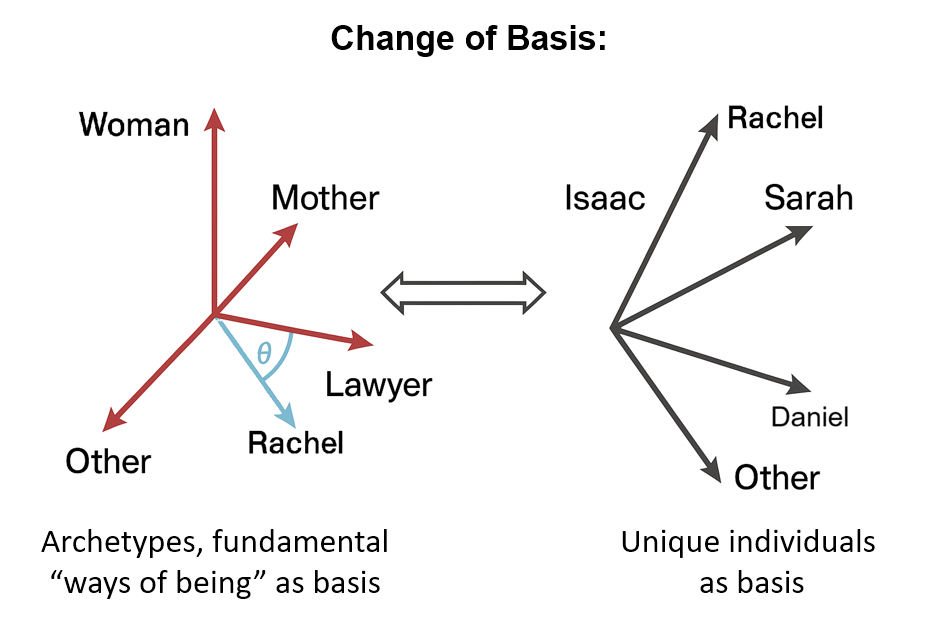
So the tension is something like a disagreement about basis vectors. In linear algebra terms, both extremes can represent the same identity space, but they disagree fundamentally about what the axes should be. One prefers a basis of clean, interpretable archetypes—directions that make sense to human intuition and tradition. The other prefers a basis made of individuals, infinitely varied, with each new life adding a new axis to the space. The transformation between these two coordinate systems makes is frustrating, politically consequential, and makes it hard for us to talk about the same thing with compeletly different internal basis vector.
I wonder if the tendency to perceive archetypal characters within individuals has something to do with how deeply one has internalized stories from the Bible, myth, or other religious traditions, whether simply through exposure or through a kind of narrative familiarity that makes those patterns feel like the natural structure of reality. The more fluent someone is in those symbolic systems, the more likely they are to see others as echoes or instantiations of those roles.
There’s also a temporal aspect here. Humans don’t begin as fully individuated selves, they grow into them.
And in that process, archetypes serve a real developmental function. A child or teenager doesn’t build a unique identity
from scratch. They need a scaffolding, a script to try out. So we imitate. We play roles. We go through phases. Hero, outcast, rebel, caretaker, leaning into or away from our
gender or racial identities. As we play out different situations through these archetypes (quite literally as play for young kids) we each develop each of these abstract roles,
i.e. how would a hero or a "real man" handle this situation, we each develop a more fleshed-out understanding of these archetypes, as well as ourselves.
These roles give us direction in an otherwise overwhelming space of possibility. They’re like basis vectors we can borrow while learning to chart the space on our own.
But over time, the goal is not to become the archetype. Instead, it’s to internalize its lessons and then move beyond it, toward something richer, more composite, more real.
From this perspective, the conflict between archetype-based thinking and individual-based thinking to me encompasses many of the tensions between a liberal and conservative extreme world view. One sees archetypes as the fundamental and hyper-real building blocks of our identities, the abolishment of which is chaos and a loss of a part of one's identity. The other sees them as antiquated, regimented walls hindering one's development and individuation.
In the current day we no longer take race or ethnicity-based archetypes (or stereotypes) seriously for the most part, and are in the process of doing the same to those related to gender, sexuality and perhaps species. I think most people, with the exception of those at the very extremes would also agree that archetypes can be helpful, powerful, even necessary in developing one's identity, with some amount of debate which specific ones should be kept around. But in the end they're not ends. They’re coordinates, not destinations.