Why is it so Hard to Nail Down Intelligence?
Note to self: Rewrite, or split. The original point of this was supposed to be: Intelligence is conditional on an environment. What's intelligent in one environment vs another depends on what is correct/works.
Aspects are:
First order Intelligence: Space of behaviors and conditionals that elicit them hardcoded. I.e. slime mold always solves nutrient transport optimization problem, without having to learn to do it. Embodied.
Second order Intelligence: Ability to adapt problem solving to static external environment. E.g. conditioning or associative recall. Learn what behavior works in response to what stimulus. Processing pre critical periods?
Higher order Intelligence: How well and quickly one can adapt to a different environment behaviorally by learning/forming appropriate representations, without unlearning original environment. I.e. in one context x then y is true, in another x then y is false. Sophisticated conditionals.
Directly part of and representative of fitness: How well are your body plan and instincts adapted to your environment? How flexible are you to learn patterns in the environment not originally hardcoded in your genetics. How many different behaviors can you learn for the same stimulus, and make your response conditional on a number of other factors?
What are we testing? First to second order? How well can your brain align itself to the societal tasks required and physical reality we happen to inhabit?
End of note to self.
Intelligence is notoriously hard to measure. We use IQ or the general intelligence g-factor to quantify the mean performance on a series of questions about logic, pattern recognition and spatial intelligence but of course intelligence is not a scalar quantity. It can be acquired to some extent, be highly situational, and categorized into specific types.
Another concept that is hard to pin down is fitness (in the survival of the fittest sense). The evolutionary logic here is somewhat circular: It's impossible to assign a level of fitness to an organism in isolation. Instead, an organism that has high fitness is one that is evolutionarily successful in its environment or niche, but the only way to measure an organism's fitness is to wait and see if it's evolutionarily successful. Even then there's the question of timescale (will the organism burn through its environment and go extinct in 100 years?) and adaptability to natural fluctation of the conditions on all timescales. Any metric or simulation of fitness (other than letting the universe running the experiment earnestly and coming back with a result) will be biased by the artificial environment or limited scope of the lab experiment used to measure it and incomplete as only some aspects are explored at best, As a number you can assign to an organism it serves no predictive power for real organisms, although it's a useful to simulate and understand evolutionary dynamics. This looks like an important case of computational irreducibility: You're not going to be able to predict the answer without letting mother nature take it's course, no shortcuts.
My sense is that this is a good way of thinking of intelligence: You can run tests and try to predict performance all you want yet the only true way to see if someone will succeed is to let them try to succeed at their goal and are successful.
In fact, I would argue the distinction between fitness and intelligence is a human construct. Evolutionarily, the driving force for the development of intelligence and the nervous sysyem as a whole is nothing but increasing an aspect of one's fitness, the ability to react to external stimuli in a way that is benefitial to one's surviving and thriving in a complex environment. From this perspective it's not surprising that intelligence in the animal kingdom is as diverse as the niches different organisms are filling. Slime-molds solve problems even humans find difficult like network optimization or maze solving despite a complete lack of a nervous system, among many other examples.
The narrow notion that intelligence is one's ability to sit down and take a test probably is only a marginal improvement over the old ways, and even models using mutlipe axes of intelligence are at best highly human-centric, biased and short-sighted. Instead, I think intelligence should be viewed as nothing more than a human label for a part of an organism's fitness, maybe something like dynamical/behavioral fitness.
Human intelligence as part of a Hierarchy
In a goal-oriented or problem-solving sense, intelligence is probably best understood as one rung on a ladder of a larger hierarchy. A book that explores this idea nicely is Bobby Azarian's The Romance of Reality, also Harold Morowitz's The Emergence of Everything, and of course this idea has been propounded by Mike Levin at Tufts University, among others. The idea goes something like this:
Thermodynamic/molecular level:
Starting from the world of basic thermodynamics, reaction-diffusion systems far from equilibrium serve as a substrate for stereotyped non-dissipatory structures. These structures have direct access to an energy source and offset the entropy cost of "existing" can by dissipating energy (and generating enough entropy per unit time to maintain their structure). The simplest examples of structures on this level are probably vortices, solitons or breathers or wave-like Turing patterns.
Sturctures like this experience a "pressure" to maximize entropy production. This is a consequence of Jaynes' principle of maximum caliber, as it can be shown that the stationary state for such a system is one with extremal rate of entropy production, so the system either dissipates or tends toward maximum entropy production rate. Given a accessible configuration space that the system can explore, it will tend to spontaneously organize into a structure that maximizes this quantity and, assuming the existence of mechanisms for selection (proliferation, diffusion in configuration space, reciprocal catalysis) over time versions of the structure develop that maximize this quantity better and better. Jeremy England has interesting work on this topic, e.g. the simulated self organization of multistable systems in a way as to maximize the dissipation of energy (link). Here systems driven by non-trivial driving forces spontaneously adapted in a way to most efficiently resonate with the energy source and optimally dissipate it.
Instead of going up in the direction of life, we could also go up to non-living structures from here. These follow the same laws as the microscopic structures, whether the laws of thermodynamics or other laws of physics. For a hurricane dissipating atmospheric pressure gradients, the scale is different, the principles the same. When these systems support non-dissipatory transport, i.e. drift or currents that carry energy, they can be themselves serve as sources of energy for smaller structures that dissipate these currents.
Cellular organization level:
Through mechanisms of entropy maximization, over time self-contained structures form that provide higher local concentrations of necessary fuel and an isolated environment that allows for more efficient reactions and entropy production. I.e. what we call simple life. The overall trend seems to be that organization that regulates the internal environment more allow the internal structures to narrowly optimize for a specific set of conditions. This is a kind of bias-variance tradeoff, where in a variable environment a generalist has the advantage as they can perform at all times, while regimented environments breed strong bias and dependence on those conditions and the emergence specialists. In a regimented environment the specialist will outperform the generalist. Jumping ahead to human intelligence, this principle should be included in any notion of intelligence. Generalist intelligence (abstraction, transferrability) emphasized versatility and adaptability, and is beneficial in unstandardized, high variance environments. This is along the lines of "teachability is more important than hard knowledge". As the environment grows more standardized and stable, this kind of knowledge is discounted with respect to narrow, specialized intelligence (I would say knowledge here, but specialized intelligence = knowledge).
While also true for smaller structures, prediction of and (anticipatory) reactions to the environment become increasingly important for cells, and even more so at larger scales of organization. Cells perfort chemotaxis, phototaxis and other behaviors that optimize survival and current as well as future entropy production by moving to energyy sources and away from danger.
My sense is that competition is actually another pathway that can lead to collaboration between competitors through reciprocal modeling, see here.
At every scale of organization the correlated system becomes more complex, parts more specialized and goals more abstract. This leads us to structures comprising multiple cells.
Multi-cellular organization level;
Similar considerations (bias-variance tradeoff, entropy maximization, survival needed for persistence over time and selection, need for reciprocal modeling) over time drive cells to form higher order, multicellular structures. Cells become more specialized and some develop into a nervous system as a faster alternative to (or maybe better to say highly specialized and optimized version of) chemical signaling. The existence of neurons is remarkable: Cells that do not themselves proliferate that maintain highly non-spherical morphologies and can not survive in isolation, relying on glia and astrocytes for glucose, waste management and pretty much all other processes. Having cultured my fair share of neurons it's impressive to me how easily they die, highlighting how optimized the environment really is.
Initially performing simple tasks like predator avoidance, the computations and sets of behaviors the nervous system performs grow more complex. Given the right architecture, networks of network gain the ability to perform more sophisticated computations. Such a network spans a brandnew space of firing activity, opening up a new configuration space to explore and optimize in. However, this is not a difference in kind, just in degree. As is the case with intercellular signalling for coordination of activity between cells (in the process providing a stable environment for entropy dissipation and long term survival), this space is only indirectly coupled to metabolism.
In a first step this can be simply a descriptive encoding, i.e. encoding the current or recent state of the environment. A notable development from here is the formation of associative systems, as implemented in our dopamine circuity. In my opinion this is the basis of abstract thought: By associating conditional patterns with unconditioned stimuli, the brain creates predictive shortcuts and equates abstract stimuli (e.g. ringing bell) with things that it intrinsically cares about (e.g. food). This process requires the "comparison" of a perceived signal with a stored prototyped reference signal or circuit in the brain. What is needed to go to (conscious?) abstract or symbolic thought is for the nervous system to go from merely encoding these prototypes to manipulating by combining (union) or conditionalizing (intersection). These are basic symbols, semiotically ungrounded prototypes that the brian can operate on.
This is the scale we operate on, generalizing to prototypes from real objects and phenomena we experience.
Civilizational or Inter-Organism level:
On the scale of individual multicellular orgamisms (us!) the same driving forces that drove cells to assemble in the first place lead to the formation of colonies, herds, tribes and bands. Through communication, both descriptive information (Who? What? Where? When?) and abstract cognitive prototypes can be shared. The latter, disembodied concepts that themselves propagate and are selected for in the substrate of groups of individuals are memes in the Richard Dawkins sense. As an aside, it seems like there's a more general dual relationship needed (?) for selection, i.e. some adaptation, trait (gene) or concept (meme) spawns and benefits the host, which in turn makes it more likely for it to spread outside of the host. One can frame this process in terms of the host or the adaptation. I wonder if this can a) be formalized and b) re-expressed better in terms of Terrence Deacon's reciprocal catalysis.
This is the dawn of civilization/culture and this leads to an even higher order configuration space for exploration, the space of inter-organism (or inter-personal) organization.
Where does intelligence fit in all this?
From this description it should be apparent that ourselves, our nervous systems and conscious problem solving abilities (i.e. intelligence) is a part of a much larger story of ever growing scales of organization. The concept of a individual, disembodied general intelligence misses this context. Intelligence is not fully individual in the sense that it is conditional on the environment and culture. It's not disembodied in the sense that it's only a highly specialized part of a larger organism with a plethora of different components, and is entirely dependent on them. And finally is not general as it's highly adapted to and specialized to the environment and culture above, and limited in scope by sensory modalities and attentional spotlights implemented from below.
Some Additional Thoughts
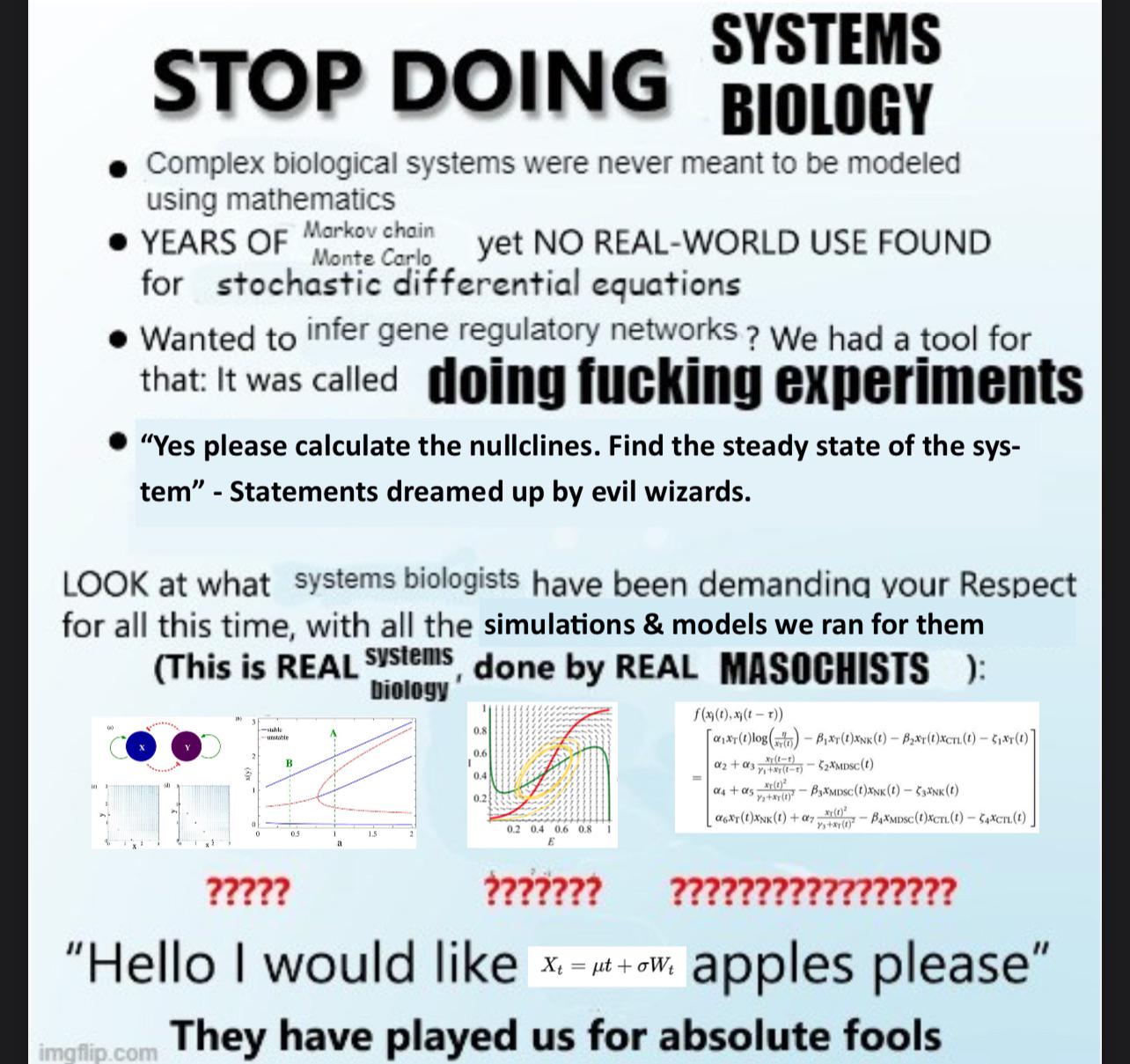
Obligatory Biologist Bashing
Writing about all this systems thinking and memes reminds me:
Comment on IQ and measurements
In the context of Gardner's theory of multiple intelligences for instance, we have logical/mathematical, linguistic, musical, visual/spatial, inter/intrapersonal (~EQ), bodily/kinesthetic types of intelligence among others. These distinctions can be useful in staying humble and appreciating one another's unique talents and abilities but in my opinion are nothing more than a PCA expansion of a more complex underlying structure (though this is still better than just taking the mean or IQ).
IQ (and multiple intelligence models) cover no more than 25% of the observed variance (with r-values around 0.5), 75% remaining unaccounted for, and not for a lack of trying. I wonder if this endeavor is fated to be as fruitless as a biologist a biologist trying to assign a fitness value to a fly locked in a jar. A persons intelligence is as varied and versatile, but also as specialized and standardized as their life itself. The utility of intelligence is also greatly amplified over time when it's in properly integrated with other levels or organization (drives, healthy nutrition, social context, ...).
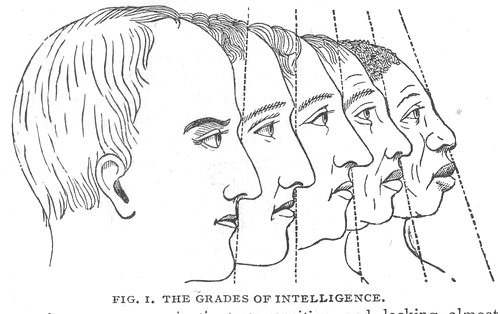
My sense is also that this general our culture shares this skepticism. Bragging about one's IQ or taking it overly serious is seen as a sign of immaturity and a naive and narrow-minded world view, and a high IQ may sound impressive on paper but is nothing compared to a genuine example of real-world success and fulfillment. We look at antiquated methods of predicting intelligence based on racist ideologies or phrenology (skull anatomy) with disbelief about how people could believe that these arbitrary characteristics could be predictive of future performance in life. While this is something we've overcome, the belief that the right way to measure intelligence is a standardized test attempting to measure spatial thinking might be teaching us more about ourselves than it teaches us about intelligence.